Posts

Marmalade Frozen Yoghurt

Image
I first came across marmalade ice cream sometime in the 1980s when Sophie Grigson published the recipe in a London evening newspaper. At least, that's if my memory is to be trusted, which it's not for the most part. Essentially the recipe is a simple combination of double cream and marmalade and produces a rich, no churn ice cream beloved by just about anyone who tries it. Very similar recipes have appeared quite often over the years since then. I thought I'd try making a lighter version of this little treat using zero fat yoghurt and I'm pleased to say that it works well. Let's not pretend that it's healthy, though: there's virtually a whole jar of marmalade in this recipe. Until recently I would usually strain low fat Greek style yoghurts when making frozen desserts but there are some in the shops now that are thick enough to make that unnecessary. I've tried making this by simply putting the mixture in the freezer and also by using my very basic i...

Asparagus and Almond Milk Risotto

Image
When it's in season I never really get bored with simply cooked asparagus but, just for a change, I do use it in some slightly more involved recipes. I've often made a simple asparagus risotto in the past but this year I've played around with different flavours that complement and enhance the asparagus.  Almond milk provides a good background flavour and gives the risotto a creamier texture.  It might sound odd but I think that a little ginger in the stock intensifies and highlights the taste of the asparagus.  Don’t overdo the ginger, though, or you won’t taste much else. The easiest way to create a little ginger juice is to squeeze about ½ - 1 inch of peeled fresh ginger in a garlic press; although you could use a commercial ginger extract instead. I served this risotto with a little jamón ibérico (I do mean a little - I can't afford a lot) and a small, simple salad of red pepper. I love both of those flavours with asparagus but in a way they're just icing on th...

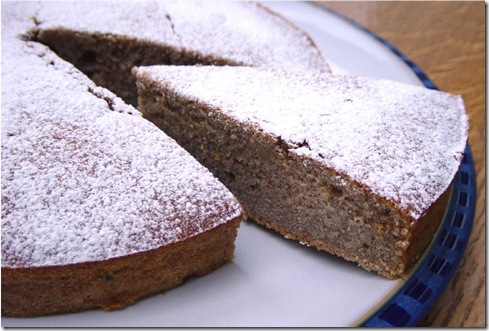
Gâteau Ardéchois or a Chestnut Cake from a Can

Image
Several years ago I was called on to make some cakes as part of a birthday celebration. That's normally pretty straightforward but at the time I was down in the south-west of France, in the Gers, and I wasn't quite sure what the local French people would make of British cakes. After all, the mayor had been invited and you certainly don't want to upset him. We decided that small chestnut cakes covered in icing would be a bit different and a good alternative to some of the other delights on offer. They turned out OK but I did notice that some of the French guests seemed to look at them a little oddly. Maybe I'd overlooked the French tradition of chestnut cakes and gone a little bit too far from the norm. After that experience I started looking for a more traditional form of chestnut cake and since they've got an awful lot of chestnuts in the Ardèche, that seemed like a pretty good place to start. To be honest, I'm not absolutely sure how close this cake might b...

Porc aux Pruneaux

Image
Sometimes it seems as if this blog should really be called ‘Some Old Bloke's Half-Remembered Meals’ and I'm sorry but here's another one. This particular nearly forgotten dish is based on something that I ate in Chinon many years ago. Chinon is a lovely little town with a fine castle, the river Vienne, some very pleasing wines and a number of good restaurants. Well, it did then and I feel sure it still does. This dish is easy to put together, quite rich and definitely old school. It's based on a dish from Tours, which is not far from Chinon, but I'm pretty certain the version that I ate used a Chinon white wine. It can be quite hard to find white Chinon wine in other parts of France let alone outside of the country, so use another dry white wine instead – a Chenin Blanc would be ideal. Traditionally, I'm sure it would be more normal to cut the pork into noisettes and fry them rather than roasting the fillet whole, but I prefer the roasting option – it’s eas...

The Professor Denies Everything Or A Review of The Poi’s Son

Image
It's not escaped my notice that lots of bloggers write restaurant reviews but, so far, I've been far too idle to follow suit. But when a new pop-up restaurant opened nearby I couldn't miss the opportunity to pass on the good news. The Poi's Son Of Avril is in the fine tradition of many modern restaurants: find an unexploited, cheap foodstuff and make it fashionably expensive in a room with ridiculous decoration. The speciality of the Poi's Son Of Avril is Hawaiian Poi and they boast not only a chef who is a master of this ancient culinary art but also quite a lot of dry rot. I quickly perused the Blogger's Guide to Restaurant Reviewing and discovered that if you don't find yourself fascinating enough then you need to take an interesting companion with you. The Professor is usually interesting if not always entirely sober and he was more than happy to accompany me. At least he was after I threatened to tell his wife about the incident with the exotic dancer...

Carrot Halwa For Al

Image
I think of Al whenever I see carrot halwa on the menu of an Indian restaurant (and, believe me, that's quite often). Al did a lot of the cooking at iDEATH. His signature dish was ‘mess of carrots’. Al was definitely known for his carrots. When he and Pauline cooked together ‘they made a potato salad that somehow ended up having a lot of carrots in it.’ I think if Al made a dessert, then this would be the one. It would probably be sweetened with watermelon sugar. In the early 1970s when I first read Richard Brautigan’s ‘In Watermelon Sugar’ it seemed an extraordinary book and, as it happens, it still does today. The book was actually written in 1964 and published in 1968 and I can't imagine it being written in any other decade. The narrator (‘Just call me whatever is in your mind’) lives in a shack near iDEATH and tells us of his life in a place where many things are made of watermelon sugar and the sun shines a different colour every day. I'm wondering what the people ...

Gâteau Battu

Image
In Picardy, near the mouth of the Somme, lies the ancient region of Ponthieu (unless I've got my geography wrong again) where there lives a strange beast known as the Gâteau Battu. This translates as ‘beaten cake’, but imagine a tall, light, buttery, yeasty brioche and you'll be somewhere near it. I first tasted this gâteau over a decade ago and, although I loved it, I didn't think about trying to make it at home. Then a few years ago, I met Michel Savreux, chef and member of the Confrérie du Gâteau Battu. His enthusiasm for local food and the Gâteau Battu in particular inspired me to attempt to make my own version. (I was particularly impressed when I was shown the truly wonderful hat in the shape of a Gâteau Battu that members of the Confrérie wear on ceremonial occasions). It turns out that making a Gâteau Battu on a small, domestic scale is not quite as easy as I thought it might be. It's not that the basic recipe is a secret – the Confrérie have published a recip...