Posts

The Malakoff Trifle

Image
The Malakoff torte is a refined item of patisserie, which allows the more experienced and skilful dessert maker to show off his or her talent. But we're not going there. Instead we're going back to 1970s England where a much less refined and more relaxed dessert with a vaguely similar set of ingredients turned up on the menus of a number of restaurants. Sponge fingers, cream mixtures, perhaps some almonds or chocolate and plenty of rum were piled into colourful dishes and plonked in front of grateful punters. Being the 1970s, it was a seriously rich and indulgent dessert but it was also a seriously tasty one. Shortly afterwards tiramisu became fashionable and, following a brief but gooey skirmish, the Malakoff Trifle was history. (Actually, it may not have been called a ‘trifle’ at the time - I can only remember the Malakoff bit of the name). This is my tribute to that abandoned dessert. I've made it a little lighter by not using buckets of whipped cream, although I'm...

Caghuse Or Something A Bit Like It

Image
The cuisine of Picardy is not the best-known or trendiest style of French cooking but I don’t care. I like it anyway. The dishes tend to be straightforward, made with familiar ingredients and are full of strong, comforting flavours. Admittedly, some of them can also be pretty rich and a stranger to the notion of portion control. Caghuse is one of the more restrained Picardy recipes. It’s often served cold in Picardy but, while there’s nothing wrong with that,  I think it’s nicest served hot on a cold day. There are different ways of spelling the name of this dish and there are many different ways to make it too. Essentially it’s a one pot dish of slow-cooked pork with onions and vinegar but there are plenty of possible variations along the way. I use chicken stock and cider but beef stock and beer can be used instead. You could also add some herbs to the dish, if you fancy – sage and thyme work well. Strictly speaking, the pork should be cut from the leg and should be on the bone...

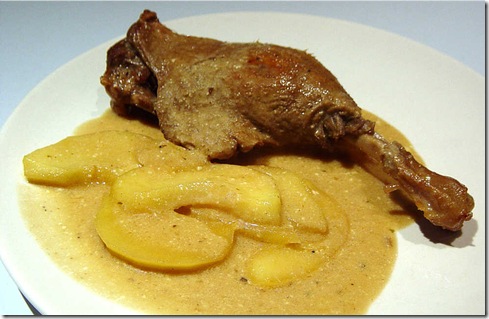
The Duck Legs of Normandy

Image
Duck is one of my favourite meats, but it does tend to be a bit expensive. Duck legs, though, are the cheaper option in most supermarkets. A while ago I got into a discussion with someone who was looking for new and interesting ways to cook duck legs. I can’t quite remember what conclusions we came to but afterwards I started wondering what was wrong with the traditional methods. To my shame, I hadn't made this sort of dish for years and I needed reminding just how good it can be. There’s nothing new or revolutionary about this recipe. It’s the method of Normandy cooking that I first picked up years ago, although there’s no guarantee that it would be considered truly authentic in the Vallée d'Auge.  Very much the same method of cooking is often used in Normandy for chicken or guinea fowl, although they will usually require less time to cook. I did use a genuine Normandy cider for this dish but it’s not the only place in the world that makes excellent cider. Most decen...

Kedgeree's Eccentric Cousin

Image
Once upon a time, when I was still young and foolish, a lady friend offered to cook me dinner. She made a classic kedgeree and very nice it was too. The second thing she cooked for me was also kedgeree. So was the third and the fourth. It turned out that kedgeree was the only dish she could cook. After a while,  she went off with an annoyingly handsome bloke from Sweden who played electric violin. Another friend of mine offered to cheer me up by making me dinner. She made me kedgeree.  It hasn't put me off, though; I still love this British classic. Although, after all these years and several shedloads of kedgeree, I do tend to throw in a few variations now and then. This version has so many variations that I don't think it’s quite kedgeree any more. One major variation is that I use short grain brown rice, which adds nuttiness and extra texture to the dish.  (This type of rice isn't common in supermarkets but you can find it in health food shops.) Rather than smoked ha...

Sand Cake with a Drizzle Topping

Image
Sand cakes have been around in England for a very long time but they don’t seem to turn up all that often these days, unless I'm missing them somehow. In fact, various types of sand cakes seem to surface more frequently in other parts of the world such as Australia. The cakes don’t have sand in them, honest. They’re made largely with potato flour or cornflour (or cornstarch as it’s known in some parts of the world), which gives them a light and crumbly texture – a ‘sandy’ texture, I suppose. It’s a shame that they’re not better known because they’re beautifully light, very easy to make and they taste a lot better than sand. Traditionally the cakes are associated primarily with Leicestershire, although in my head they’re forever associated with Ironbridge in Shropshire because that’s where I first came across the cake in a small, old-fashioned tea shop quite a few years ago. Many of the traditional recipes call for the cake to be iced with a light, usually lemon, icing but I'...

Braised Turnips With Mustard And Chervil

Image
The turnip has an image problem in this country. Perhaps that's not so surprising. I can remember some pretty terrible meals accompanied by grey and unpleasant turnips in the distant past. Fast forward a few years and I was eating turnips in France and realising that they can be absolutely delicious. I've been growing an old French variety ‘Des Vertus Marteau’ for a couple of years now and the flavour and texture is probably the best I've found. Better still, they’re really easy to grow and quick to crop. So if you have a little spare ground, then I recommend trying some. Unless you live in France, you're unlikely to find the seeds of this or other similar French varieties at the local garden centre but they are quite widely available from suppliers of heritage seeds.  Chervil has a bit of an image problem in Britain too. It never seems to be as widely available as other fresh herbs in shops and supermarkets. But chervil has a lovely flavour and looks good as a garn...

Melon Sorbet or Something Like It

Image
If you’re anything like me, then whenever you buy a delicious, ripe melon, you have the problem of leftovers. I wrap the excess melon and stick it in the fridge for the next day.  I then usually forget that it's there and discover sad, dried up melon some days later. So that's why I came up with this solution to the problem of excess melon. Actually, it turns out that this sorbet is so refreshing and so ridiculously simple to put together that I'm quite happy to buy yet more melon just to make it. Unless my memory is playing tricks on me (yet again!), this sorbet is based on a recipe by the great Frédy Girardet . I'm sure that the original would have been more refined and would not have contained Malibu. But Frédy Girardet is a great chef and I'm most definitely not. The sorbet will certainly be smoother if made in an ice-cream machine, but it will still be very pleasing if you simply freeze it in a shallow container and rough it up a bit with a fork once it’s ...