Posts

Rosé Veal with Pears and Apricots

Image
These days Surrey is probably better known for commuting than farming but there's actually some very fine produce available locally. One product that's become increasingly common over the last few years is rosé veal. (I know that some people say rose  veal and others say rosé veal but since I've no idea which it should be, I've chosen rosé at random). It's a very adaptable meat but, for me, it really comes into its own in this lighter type of casserole. The veal I used came from an excellent local producer, Hunts Hill Farm , who have a farm shop open several days a week as well as being a familiar fixture at several of the local farmers' markets. This recipe is based loosely ( very loosely) on a Spanish dish but the way I make it isn't in the least authentic. On the other hand, since it was born in Spain, I couldn't resist adding a little Pedro Ximenez sherry to finish the dish - that's optional, but very nice. You could also use a PX vinegar ins...
Sweet Wine and Olive Oil Cake

Image
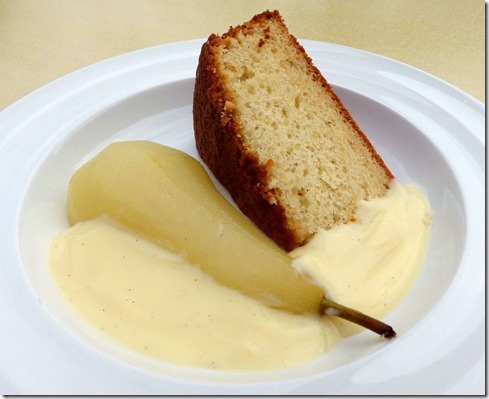
There are plenty of recipes for cakes made with olive oil knocking about but not too many that use a dessert wine as well. Well here's one that I found under a bush in the Languedoc. It produces a moist cake with a fruity flavour that's a little bit different to the norm. Since it's a bit different, I'm not sure that it's the typical British afternoon tea cake, unless your chosen beverage is a fruit tea or maybe a fragrant Earl Grey. Admittedly, others who have tried the cake disagree and like the fact that it adds variety, so what do I know? On the other hand, I do know that it works really well as a dessert cake alongside some fruit and maybe a little crème anglaise or cream. I paired it with a poached pear this time, which is lovely but isn't particularly Languedoc. Poached apricots or peaches would probably be more of a southern French choice. This is a very straightforward cake to make but it's important to choose the wine and oil carefully. Don't...

Le Frésinat

Image
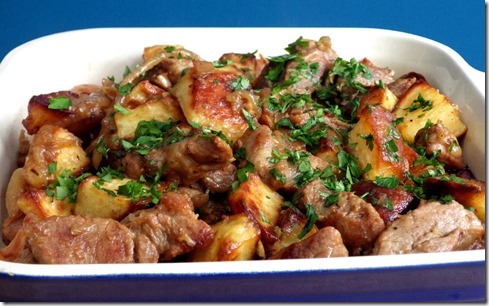
Le frésinat is a simple country dish from the Tarn region of France that consists mostly of pork and potatoes. That doesn't sound too promising but the combination of ingredients produces an intensely savoury and satisfying dish that's just perfect for winter. It's said to be the meal that was traditionally cooked as a thank you to the friends and neighbours who helped out when the farm pig was slaughtered. I don't have a pig or a farm and so I can't vouch for that. I just use pork shoulder from a friendly, local butcher. You could use other cuts, but it's best to avoid any that are too lean. (It's also best to avoid unfriendly butchers, funnily enough). I'm not usually bothered too much about authenticity in my recipes and I often substitute ingredients. This dish, however, relies on the balance of simple flavours and I've learnt the hard way that it's probably best to not play around with the ingredients too much. For instance, if you swap t...

Speculoos – The Domesticated And Eggless Version

Image
For years I thought of speculoos as the little, wrapped biscuits that often accompanied a bad cup of coffee at conferences and business meetings where people said "going forward" a lot. Then I discovered the almost fanatical devotion to this biscuit in Belgium and northern France and I realised that speculoos must have hidden depths. These days I've long since given up the conferences and the "going forward" people but I've learned to love one or two speculoos alongside good coffee (or tea if you're making it). There's no shortage of the mass-produced, commercial product (whatever they choose to call them these days) but a lot of bakers in northern France, both professional and amateur, make their own. Many of these are more substantial than the usual commercial biscuit and a little different in texture too. Most of the recipes I've come across add egg to the mixture but I've been told that egg isn't truly authentic (although I admit th...

Normandy Lamb With Mint

Image
I've been rereading 'Flaubert’s Parrot' by Julian Barnes, which is a funny, sad, literary novel from the 1980s and in my lightweight view is one of the finest written during my lifetime. Mr Barnes refers to the Normandy travels of the Reverend George Musgrave Musgrave (that's his name,  not an accidental duplicate word) and, in particular, a conversation he reports in his 1855 book 'A Ramble Through Normandy'. The Reverend Musgrave amuses himself by questioning  'a thriving merchant of Rouen' who, despite being 'upwards of sixty years old', had never heard of mint sauce! Of course, the Reverend 'advised him to take up a new set of notions on English cookery'. It isn't what the Reverend intended but I was reminded of this dish from Normandy. Some French people (well, Parisians, at least) can still be very dismissive of British food. In my experience, if you try to defend British cooking to them, then you might well get the response...

Dulce de Leche Ice Cream

Image
In the early 1990s dulce de leche was in every supermarket and every recipe magazine. You just couldn't avoid it unless you hid in a cave far from civilisation. In those long lost days I decided it would be a spiffing idea to use the abundant supply of dulce de leche to make some ice cream. It turned out to be very easy to put together and very pleasant indeed to eat. And so I kept making it. In fact, I made it so often that people begged me to stop kindly suggested that I should maybe try another flavour. So I moved on to other types of iced delight and forgot all about dulce de leche ice cream. Then, a few days ago, I came across a notebook from my younger days that wittered on about this ice cream and I really wanted to try it one more time. My very cheap ice cream machine is a simple freeze-ahead bowl type that's not particularly efficient but that's all you need for this ice cream. In fact, you could make this without a machine at all if you put the mixture in the f...

Gâteau au Chocolat de Nancy

Image
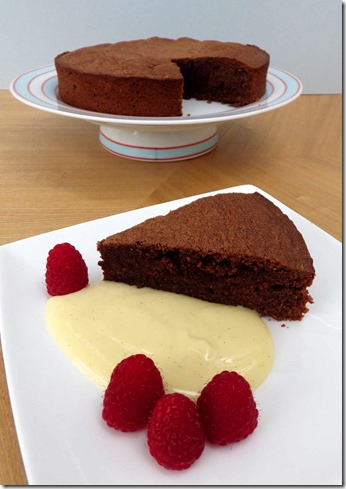
I have it on good authority that this is an ancient type of gâteau from Nancy in north-eastern France although I have to confess that I couldn't find a recipe that's older than the 1960s (due to poor research, no doubt). It's one of those classic flourless cakes which, in this case, is enriched with chocolate. There are some recipes that do add a little flour, which will help to stabilise the cake but I'm hoping that this flourless version is as light and pure in flavour as the real thing should be. It's a recipe that's easy to remember. Essentially it's equal amounts of each ingredient (if you consider the ground almonds and potato flour as a single entity) plus eggs. This is not the only type of cake that you might find described as a Gâteau de Nancy. The citizens of Nancy seem to have a number of treats at their disposal from large meringue confections to macarons and cakes flavoured with the local plum liqueur. They are obviously wise and happy peopl...